
For a long time, scientists simply didn’t know. People’s best guess was that decisions — especially important decisions — were made in a linear, three-step process.
First, the person making the decision would gather data. Then, they would evaluate options and trade-offs. Finally, they would make a decision and act on it.
Decades of groundbreaking research have proven that’s not at all how the mind works. As it turns out there is a linear, three-step process — but it’s entirely different.
We now know that what drives a decision, choice, or behavior is the result of two brain systems acting together. The neurobiology behind this decision making process has been well researched.
We know now that the first of these systems to fire is the emotional system, which is located in the limbic region. This system operates automatically, quickly, and with no effort. The limbic region — an older part of the brain located in the mid-brain — is where emotion, habit, reward, hesitation, and motivation are processed.
The second is the reason system, which is supported by the prefrontal cortex. This is the part of the brain that is analytical, evaluates risk/benefit ratios, processes the information we’re aware of, and gives us the ability to not act impulsively.
What’s important to understand is that these brain processes are inseparable: both processes are hard-wired to work in concert. The limbic region is connected to the pre-frontal cortex, which, in turn, has connections that return to the limbic region. Therefore, emotion, habit and reward-driven inputs all influence decision-making and behavior for all of us.
What our brains emphasize depends on the context of the decision to be made, the level of experience, the difficulty of the choice, the potential for perceived risk, and most importantly the emotional connection to the decision.
Emotions set the context for the reasoning. When a decision maker says, “I’ve thought a lot about it, and this decision feels right” that’s scientifically accurate: the decision maker has found the reasons that make sense and fit the context his or her emotions have set. This emotional context is also true of behaviors. When a person says, “Bob didn’t stick with his decision — I guess his heart wasn’t really in it” that also has a sound basis in science. When people force a decision that doesn’t match the context their emotions set, they will tend to revert to prior, more familiar behaviors “they feel good about”.
People don’t decide with their heart or with their head. They decide using both, and the emotion system always fires first, and is always the dominant factor in weighing out the reasons for any decision.
In marketing, people have many theories about obstacles to sales. What marketing neuroscience can tell us is how real (or not real) those obstacles are, and how big they are. What the marketing team expects to be the most important obstacle sometimes turns out to be only 10% of what drives a decision. An unspoken emotional priority might be four times more important. What happens when the focus in marketing and sales starts with the wrong emotional priority? The customer’s brain clicks off.
They can’t hear what you say – or may even want to push back — because the conversation started on entirely the wrong foot.
For obvious reasons, marketers have always wanted to know how people decide and act.
But just like scientists, for a long time marketers simply didn’t know. Running an emotionally-driven ad campaign might sometimes drive success – but only sometimes.
When it worked, everyone involved would triumphantly claim they had at last found the emotional key. But when the next campaign failed, reality would set back in: making a lucky guess is not the same thing as having identified a reliable method for finding success again.
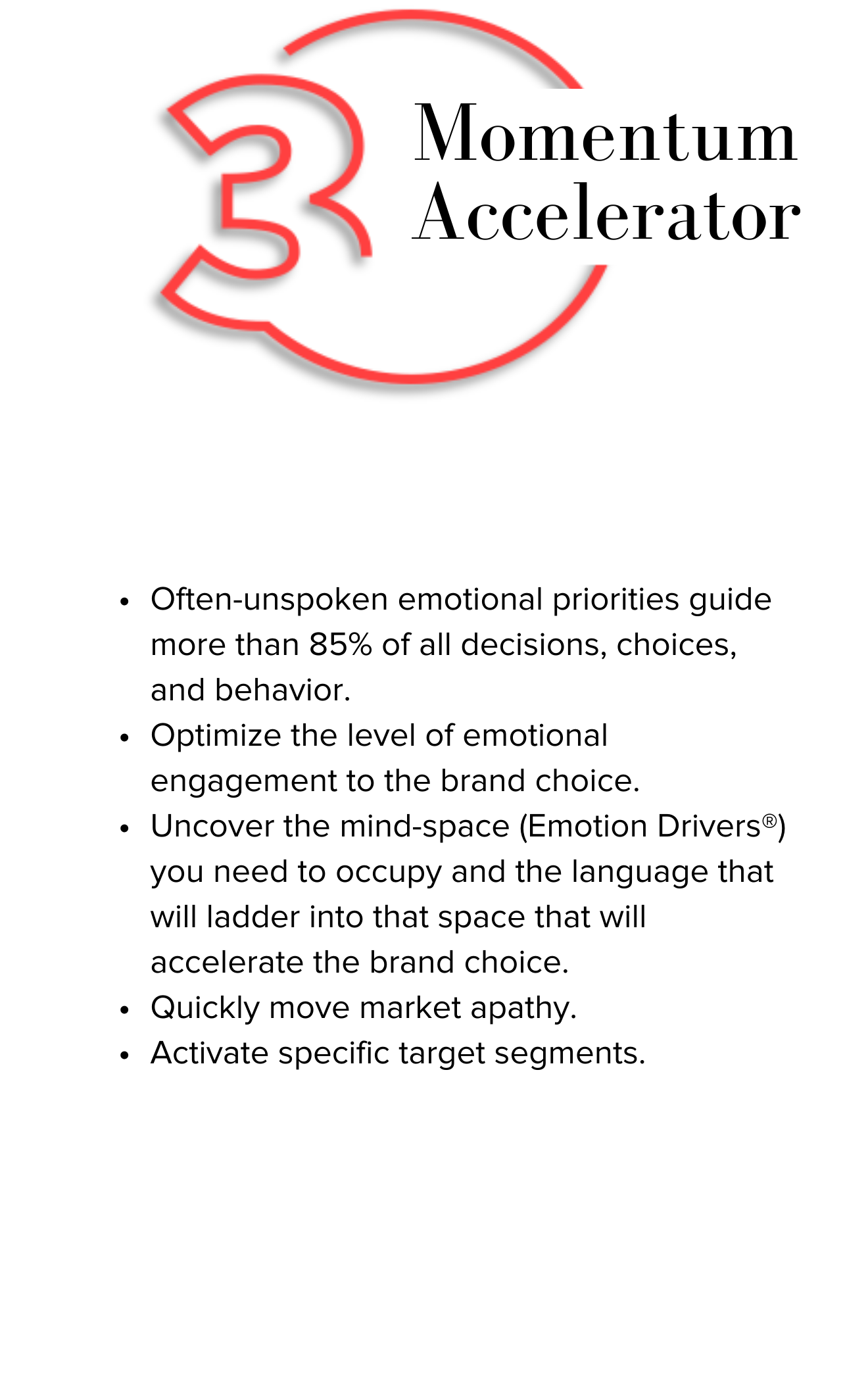
More than 85% of all buying decisions are guided by often-unspoken emotional priorities. These are priorities that the traditional marketing toolkit is blind to, because the processes don’t create the right environment for customers to reveal their true selves.
For the past two decades Brain Surgery has developed and fine-tuned a patented approach that enables marketers to apply neuroscience to marketing and make it actionable.
First, we tap into the integrative decision-making process by knowing how to engage people’s emotion first and only then connecting it to the underlying reasons that cause them to make decisions.
Next, we map those unspoken emotional priorities to every marketing activity, to every important audience. For example, in complex, high-stakes, fast-moving markets like pharmaceuticals we might consider everything from the language sales representatives use when approaching physicians, to how language is crafted in advertising, public relations, and social media, and beyond.
Lastly, because high-stakes markets do not remain static, we remain engaged with the marketing team as the “emotional voice of the customer” in their ear. We check back in with the market regularly to understand how it is evolving, so that the brand stays in sync with how customers and prospects decide and act.
Brain Surgery is firmly rooted in customer needs, but it is advanced and distinctly different from traditional marketing. Our work is the most effective when:
1. The brand is in a high-stakes market where a single share point can be worth millions of dollars;
2. The brand leaders possess the courage, savvy, and internal political skills to help their organizations unlearn “this is the way we’ve always done it” and grow into a new approach.
With that in mind, we’ll leave you with these prescient words from Alvin Toffler:
“The illiterate of the 21st century will not be those who cannot read and write, but those who cannot learn, unlearn, and relearn.”
There’s no better feeling in marketing today than to lead a team that does those three things better than any of your competitors.